
What Size Air Conditioner Do I Need For A 2000 Square Foot Home?

Getting an air conditioner installed in your 2,000 square foot home requires more than picking a random unit from a catalog. Your HVAC system must match your home’s cooling needs. If you choose the wrong size, you will feel it in your comfort and in your electric bill. Many homeowners ask, “What size air conditioner do I need for a 2000 square foot home?” The answer depends on several credentials and key factors.

You must review cooling capacity, square footage, ceiling height, insulation quality, and the local climate before moving forward. Keep reading. We will break it down step by step so you can make a smart decision.

Start With Square Footage

Most people begin with square footage. This makes sense. A 2,000 sq ft house needs more cooling power than a smaller unit designed for a 1,200 sq ft home. Many contractors use a general rule of thumb. They estimate about 20 BTUs per square foot. BTU stands for British Thermal Unit. It measures AC cooling capacity.

Ac Size Guide For 2000 Square Foot Home
Central Air Installation Sizing Guide

For a 2,000 square foot home, that rough estimate suggests around 40,000 BTUs. That equals about 3 to 3.5 tons of cooling, since one ton equals 12,000 BTUs. Your home’s square footage gives you a starting point. It does not give you the final answer.

Why AC Size Matters More Than You Think

Choosing the right size AC unit protects your comfort and your wallet. If you install a smaller unit, it will run all day and struggle to push cool air through the house. Your energy bills will climb. Your AC system will wear out faster.

If you install a larger AC unit, it will cool the air too quickly and shut off before it removes humidity. Your home will feel damp and uncomfortable. That larger system will also cycle on and off too often. That constant cycling reduces energy efficiency and shortens the life of your HVAC equipment. You need the right size AC unit. Not too big. Not too small. Just right.

The Manual J Load Calculation

If you want a real answer to “what size air conditioner do I need,” you must request a Manual J load calculation. HVAC professionals use this detailed load calculation to determine how hot your home gets during the entire cooling season.

A proper Manual J calculation evaluates:

  • Total square footage
  • Ceiling height
  • Sun exposure
  • Insulation quality
  • Construction materials
  • Window size and placement
  • Local climate and climate zone
  • Number of occupants

This professional load calculation provides the most accurate method for sizing system components. Many HVAC contractors skip this step and rely on guesswork. That approach leads to oversizing or undersizing. Always insist on a Manual J load calculation before you select a new HVAC system.

Climate Zone & Local Weather Conditions

Your climate zone greatly affects the air conditioner size you need. A 2,000 square foot home in Texas requires more cooling capacity than a similar home in a mild coastal region.

High humidity also increases cooling requirements. Your cooling system must remove heat and moisture from the air. If you live in a hot and humid area, your HVAC system must handle both. Local climate directly affects AC size. A professional load calculation accounts for average summer temperatures and how much heat your home absorbs.

Ceiling Height Changes the Equation

Standard load calculations assume an 8-foot ceiling height. If your home includes vaulted ceilings or open living spaces, you must factor that into your load calculation.

Higher ceilings increase the total air volume inside your home. More air volume requires more cooling power. A 2,000 sq ft house with 12-foot ceilings may need a larger system than a similar home with standard ceilings. Do not ignore this detail. It quickly changes your unit size calculation.

Call Us Today

24 Hours a Day, 7 Days a Week.

Insulation Quality & Construction Materials

Insulation quality directly impacts energy efficiency. A poorly insulated home loses cool air faster, which forces your air conditioning system to work harder. Homes built with modern construction materials and strong insulation standards often require less cooling power. Older homes with outdated insulation may need a larger unit.


Sun exposure also plays a big role. Large west-facing windows will increase heat gain in the afternoon. That heat increases your cooling needs. When HVAC technicians perform a detailed load calculation, they evaluate how much heat enters your home through walls, windows, and roofing materials.

Hvac System Sizing Calculation For Homes
Air Conditioner Tonnage Chart For Residential Use

Understanding BTU Rating & Tonnage

You will often hear contractors refer to tonnage rather than BTU rating. One ton equals 12,000 BTUs per hour.


For a 2,000 square foot home, most central air conditioning systems fall between 3-4 tons. That equals 36,000 to 48,000 BTUs. Still, you should not assume that the range fits your home. The final size AC unit depends on your specific load calculation. Do not rely on rules of thumb alone.

Central Air vs. Packaged System vs. Heat Pump

System type also affects system size decisions. You can choose from:

  • Central air conditioning systems
  • Packaged system units
  • Heat pump systems

A central air system consists of one outdoor unit and one indoor AC unit with an evaporator coil. A packaged system combines components in a single outdoor unit. A heat pump provides both heating and cooling.

Each system type must match your home’s cooling needs. HVAC professionals will recommend the best option based on your home layout and climate.

Energy Efficiency & SEER Rating

Cooling capacity alone does not determine performance. You must also review the Seasonal Energy Efficiency Ratio (SEER). This rating measures energy efficiency over the entire cooling season. Higher SEER ratings reduce energy bills. An energy-efficient AC system may cost more upfront, but it saves money in the long run.

Do not focus only on upfront costs. A cheaper AC unit with low energy efficiency may increase your electric bill year after year. Choose an energy-efficient system that balances cooling capacity with long-term operating costs.

How Improper Installation Ruins Performance

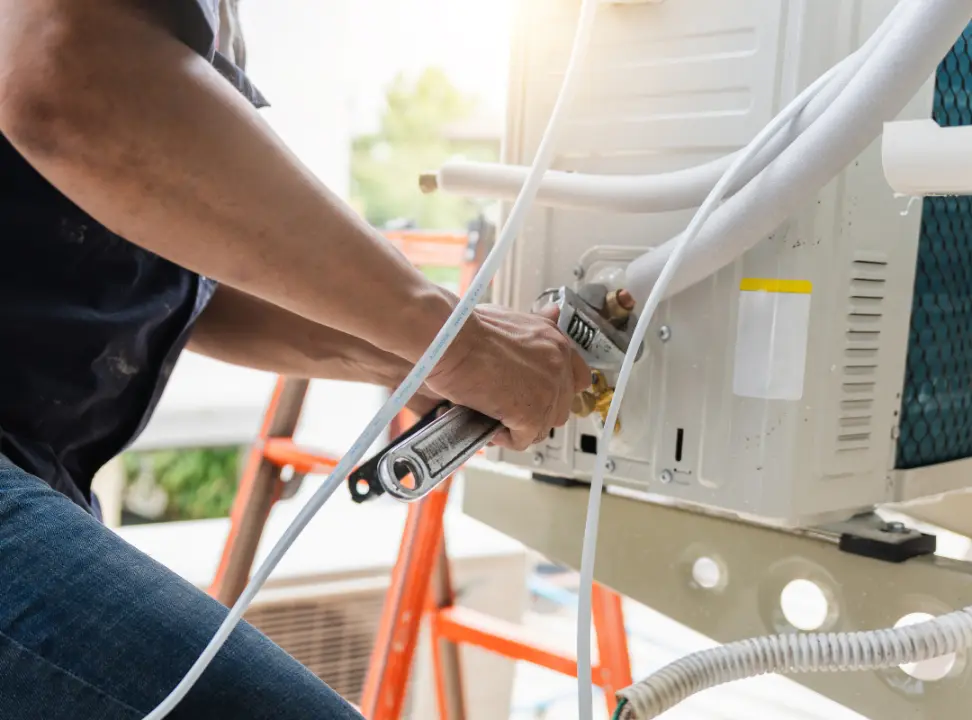
Even a properly-sized AC unit will fail if technicians install it improperly. Improper installation can reduce airflow, damage the evaporator coil, and cause refrigerant issues. Hiring an experienced HVAC company is the right way to go.

Skilled HVAC technicians will properly size AC equipment and install it in accordance with manufacturer guidelines. A well-installed HVAC system runs efficiently and lasts longer. A poorly installed larger or smaller unit will cause problems, regardless of how advanced the equipment appears on paper.

Typical AC Size for a 2,000 Sq Ft House

So, what size air conditioner do you need for a 2,000 square foot home?

In most cases, homeowners install a 3- to 3.5-ton unit. Some homes may require a 4-ton unit, especially in hotter climate zones or poorly insulated homes.

Still, you should not treat that as a final answer. Every sq ft house has unique features. The right size AC depends on a professional load calculation. If you ask, “What size AC unit do I need ?” Remember this: square footage starts the conversation. Manual J finishes it.

Your Checklist for Hiring The Right HVAC Professional

A trusted HVAC professional will:

  • Perform a Manual J calculation
  • Review your home’s square footage and ceiling height
  • Evaluate insulation quality
  • Check sun exposure
  • Discuss system type options
  • Explain cooling capacity and BTU rating
  • Provide clear labor costs

Do not let anyone guess your air conditioner size. Demand accuracy. That decision affects your comfort for years.

Get the Right AC Size for Your Home with Green Street HVAC

Choosing the wrong air conditioner size for a 2,000-square-foot home can lead to high energy bills, uneven cooling, and constant cycling that wears your system down. Green Street HVAC performs proper load calculations and evaluates your home’s layout, insulation, and airflow needs before recommending a system. 

Beyond new AC installations, our team also handles heating services, system replacements, seasonal maintenance, and fast furnace repairs to keep your home comfortable all year-round. Don’t settle for a unit that’s too big or too small. Schedule your service today or contact us and get cooling that fits your home the right way. 

LOOKING TO REPAIR, REPLACE OR UPGRADE?

Our experts can walk you through every step of the way, from prospected which tailored solution would be best for you, to installing and maintaing it…

Frequently Asked Questions

Before you move forward, you may have a few questions. Here are common questions homeowners ask Green Street HVAC.

A: Yes. Green Street HVAC conducts a detailed Manual J calculation to determine the right size AC unit for your home.

A: Absolutely. Green Street HVAC replaces your current HVAC system for energy-efficient air conditioners or heat pump systems.

A: Installation time depends on system type and home layout. Most central air conditioning systems take one full day. Larger projects or ductwork modifications may require additional time.

A: Yes. Our HVAC professionals explain the benefits of each cooling system and heating capacity option.

A: Yes. Green Street HVAC provides detailed estimates that outline labor costs, equipment specifications, BTU and SEER ratings, and the total project cost.